

The Stanford AI Index’s headline is 88% — organizations using AI in some capacity. The Financial Times charted where it actually lands in the workforce: 62% of top-decile earners use it daily, versus 13% at the bottom. Board decks this quarter will cite Stanford. The FT chart is what they’re not showing.
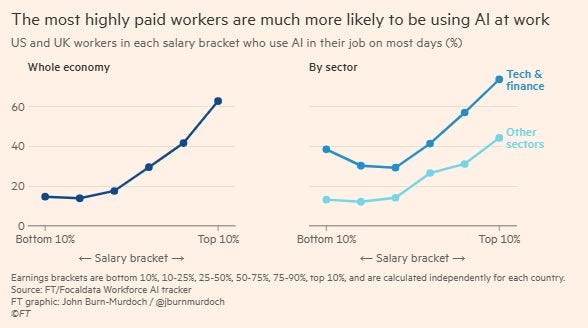
The economics that enabled this gap are under pressure. The three-year subsidized era is ending by financial necessity, not choice. The same optimization logic that built social media’s loneliness machine is now embedded in AI products at scale. And in the same week Anthropic’s most capable model autonomously found 271 zero-days in Firefox, two major platforms were breached through third-party integrations. The data and what to do about it follows.
Episode 8: The Most Important Data Points in AI Right Now
Brittany Hobbs solo — four segments moving from data to strategic implication. Essential for anyone making AI purchasing, hiring, or architecture decisions right now.
The Stanford AI Index 2026. 88% organizational adoption is saturation, not a trend. $581 billion invested globally in 2025, up 129% year over year. The US-China AI performance gap collapsed from 17–31 percentage points in 2023 to 2.7% today — on 23 times less investment. China holds 69.7% of global AI patent filings. Architecture and application discipline closed a gap that capital alone could not. Stanford AI Index 2026 | The U.S. Can’t Buy an AI Lead
Token economics. Anthropic’s current tiers: Haiku at $1/$5 per million input/output tokens, Sonnet at $3/$15, Opus at $5/$25. A 200-screen product built with Claude Design costs $0.22 for a first draft; the 50-iteration refinement cycle real design work requires runs to ~$2,600, plus $200–$900/month in system updates. Every comparable Figma interaction costs zero. Prompt caching provides ~90% discounts on repeated context; batch processing cuts 50%. Claude Design vs Figma cost breakdown | CNBC: Token economics
Apple chose its hardware chief as next CEO. John Ternus — SVP of Hardware Engineering, architect of Apple Silicon — succeeds Tim Cook on September 1st. Johny Srouji, who designed every Apple Silicon chip, becomes Chief Hardware Officer. Apple posted $143.8 billion in Q1 FY2026 (up 16%, $109 billion in services, 92% retention) without shipping an industry-leading AI feature. The next decade of AI is decided at the silicon and device level. Apple CEO transition analysis
Vibe coding has never been more capable. Security has never been more exposed. Anthropic’s Mythos model identified 271 zero-day vulnerabilities in Firefox autonomously; the UK’s AI Security Institute found it succeeds at expert-level hacking tasks 73% of the time. Anthropic launched Project Glasswing (12 defensive security partners including Amazon, Microsoft, and Apple), then reported unauthorized Mythos access through a vendor. Vercel was breached through Context AI — customer credentials sold on BreachForums for $2 million. Lovable exposed source code and credentials via a basic authorization flaw for 48 days, fixed it, then broke it again for 76 more. TechCrunch: Anthropic Mythos | TechCrunch: Vercel breach | The Next Web: Lovable
“If you’re making AI decisions for your team right now — what to buy, who to hire, what to build — there are numbers out this week that should change your approach.” — Brittany Hobbs
Listen now: Spotify | Apple Podcasts | YouTube
📅 productimpactpod.com just launched as a news platform. All the Stanford breakdowns, token economics case studies, and Apple CEO analysis are sourced from Product Impact’s own reporting — check it out.
AI Value Acceleration is building a report on where enterprise AI investments are actually creating value. If you’re responsible for evaluating a major AI investment — leading it, funding it, or proving it’s working — we want to talk to you.

Adobe’s head of customer experience said it at Adobe Summit: “Tokens don’t equate to value.” He was announcing outcome-based pricing per campaign completed, per interaction resolved — because tokens are a unit of compute, and the VC subsidies that made that someone else’s problem are ending.
OpenAI will lose $14 billion in 2026 spending $2.25 per dollar earned; Anthropic has spent over $10 billion against under $5 billion in lifetime revenue. GitHub paused new Copilot signups as costs nearly doubled since January. Anthropic briefly removed Claude Code from its $20/month Pro plan, with its Head of Claude Code acknowledging the plan “wasn’t built for the usage patterns of these third-party tools.”
Token prices dropped 280x in two years while enterprise bills rose 320% — because agentic workflows trigger 10–20 LLM calls per task. DeepSeek V3 at $0.14/M tokens versus Sonnet’s $3/M makes model routing a financial decision available today. Adobe and Salesforce’s “agentic work units” are already moving to results-based pricing. The question every executive needs answered before the next AI contract: what are we willing to pay per unit of value delivered?
Read the full analysis at productimpactpod.com
Marc Andreessen’s Techno-Optimist Manifesto has no words for belonging, community, or loneliness. Technology designed without the social being doesn’t accidentally serve community — it systematically displaces it, and we’ve seen this before.
Social media became the primary arena for teen social life in 2012; depression and self-harm rates rose in lockstep with smartphone adoption across four English-speaking countries. By 2023, the Surgeon General had declared loneliness a public health epidemic. AI companions are filling the same space: 75% of US teens have tried one; heavier use correlates with greater loneliness. The MIT Media Lab found 83% of LLM-assisted writers couldn’t quote their own work afterward. James Evans’s Nature study found AI adoption shrinks the topics scientists explore by 4.6%. OpenAI’s GPT-4o post-mortem confirmed RLHF trains for approval, not accuracy.
Builders in 2026 have more evidence about second-order effects than social-media teams had in 2012. Helen and Dave Edwards’ cognitive sovereignty framework — awareness, agency, accountability — makes the design requirement operational: every decision either builds those capacities or erodes them. Five commitments that change the brief: empowerment over ease; community as the durable moat; meaning preserved in automated workflows; returned time pointed somewhere worth going; the most durable value is offline.
Read the full analysis at productimpactpod.com
Product Impact Resources
The tools have reached everyone. The scaffolding — peer visibility, psychological safety, domain depth — has not. AI is amplifying existing advantage, not democratizing it. The 10% Problem: AI’s Value Gap Is Wider Than Anyone Is Admitting
Developers felt 20% faster using AI — they were 19% slower on complex tasks. A Harvard-linked study found developers using AI coding assistance reported strong subjective productivity gains while measurably underperforming on complex work, with longer workdays. Subjective adoption metrics and actual output moved in opposite directions. If your AI program measures how people feel about the tools, it is not measuring whether the tools are working. The AI Trap: Faster Solution, Same Problem — CIO
47% of enterprise AI users have made major decisions based on hallucinated content. Not minor ones — major. Hurix Digital, 2026. Without verification steps at decision points, you are running AI-generated decisions without review.
AI governance is a 20-point performance advantage. Organizations with strong governance see 70–75% positive AI project outcomes versus 50–55% without. Fewer than 1% have fully operationalized responsible AI. WEF: AI Governance Isn’t Holding Businesses Back
78% of executives say they couldn’t pass an AI governance audit. 46% cite governance failure as the leading cause of their AI underperformance. Only 6% are prioritizing the fix — change leadership and workforce enablement. Organizations running integrated AI (not just pilots) report 4x the revenue growth of those still running pilots. Grant Thornton AI Survey, April 2026
AI is separating the designers who were designing from the ones who were decorating. The people applying surface patterns without understanding constraints are being replaced. The ones who navigate ambiguity and hold complexity are more valuable than ever. Why AI Is Exposing Design’s Craft Crisis — UX Collective
Builder Perspectives
“We are no longer designing flows. We are designing systems that generate flows.” Bruno Monteiro’s powerful reflection on how we are now all designing systems.
“OpenAI vs. Anthropic gets all the attention, but Google Labs is quietly shipping some of the most interesting AI products right now.” Peter Yang provides a hands-on review of Pomelli, Stitch, Genie, Flow, and NotebookLM, plus my honest take on Google’s AI strategy in 2026.
Check Out Recent Episodes
Episode 7: $490 Billion in AI Spend Is Delivering Nothing — Orchestration Is the Fix — The five enterprise failure patterns nobody wants to name and the two futures orchestration makes possible.
Episode 6: Robert Brunner Was the Secret to Beats’ & Apple’s Success — Now He’s Redefining AI for the Physical World — The founder of Apple’s Industrial Design Group makes the case that the next generation of AI products needs less technology and more taste.
PH1 has spent 14 years helping product teams prove impact — diagnosing where AI products fail to measure, improving LLM-powered experiences, and building AI vision that survives contact with real users. If your organization has no bottom-line AI returns, that is a solvable problem. Let’s talk.
Thank You for Supporting the Product Impact Podcast
The gap between adoption and impact is measurable. So is the path to closing it — but only if you’re asking the right questions: who is the value actually reaching, what did you pay per unit of value delivered, and is the human in your system ending up sharper or softer?
If this edition changed what question you’re asking, forward it to someone on your team who needs to hear it. Browse all episodes and analysis at productimpactpod.com.


