

Atlassian spent three years connecting 150 billion organizational objects before the results appeared: 44% more accurate AI answers, 48% fewer tokens, a coding agent that reviewed 2 billion lines of code in two minutes. That’s the proof enterprises are pointing to when they argue that context graphs are the unlock. What the benchmark obscures is the order of operations — the graph had to exist before any of those numbers were possible.
The reorganization bet is running in parallel, and it’s moving faster than the infrastructure. Airbnb’s CHRO is converting documentation to markdown, building skills libraries, mining meeting recordings before institutional memory disappears — five structural prerequisites before the first agent goes live. Meta is posting $26.8 billion in Q1 profit, laying off 8,000 people, and reporting “horrifically, historically low” employee morale. Both are restructuring around AI. Only one is sequencing it correctly.
In AI customer experience, Twilio is working against a Qualtrics finding that 1 in 5 AI interactions delivers zero benefit. Rikki Singh’s diagnosis is precise: the orchestration layer is there, but it’s running without the context layer underneath it. FAQ automation with better packaging is still FAQ automation. The unlock is real — but only when all three pieces are in place, in order. The knowledge worker playbook in this edition addresses the fourth variable: what happens to the people whose roles disappear when the gathering does.
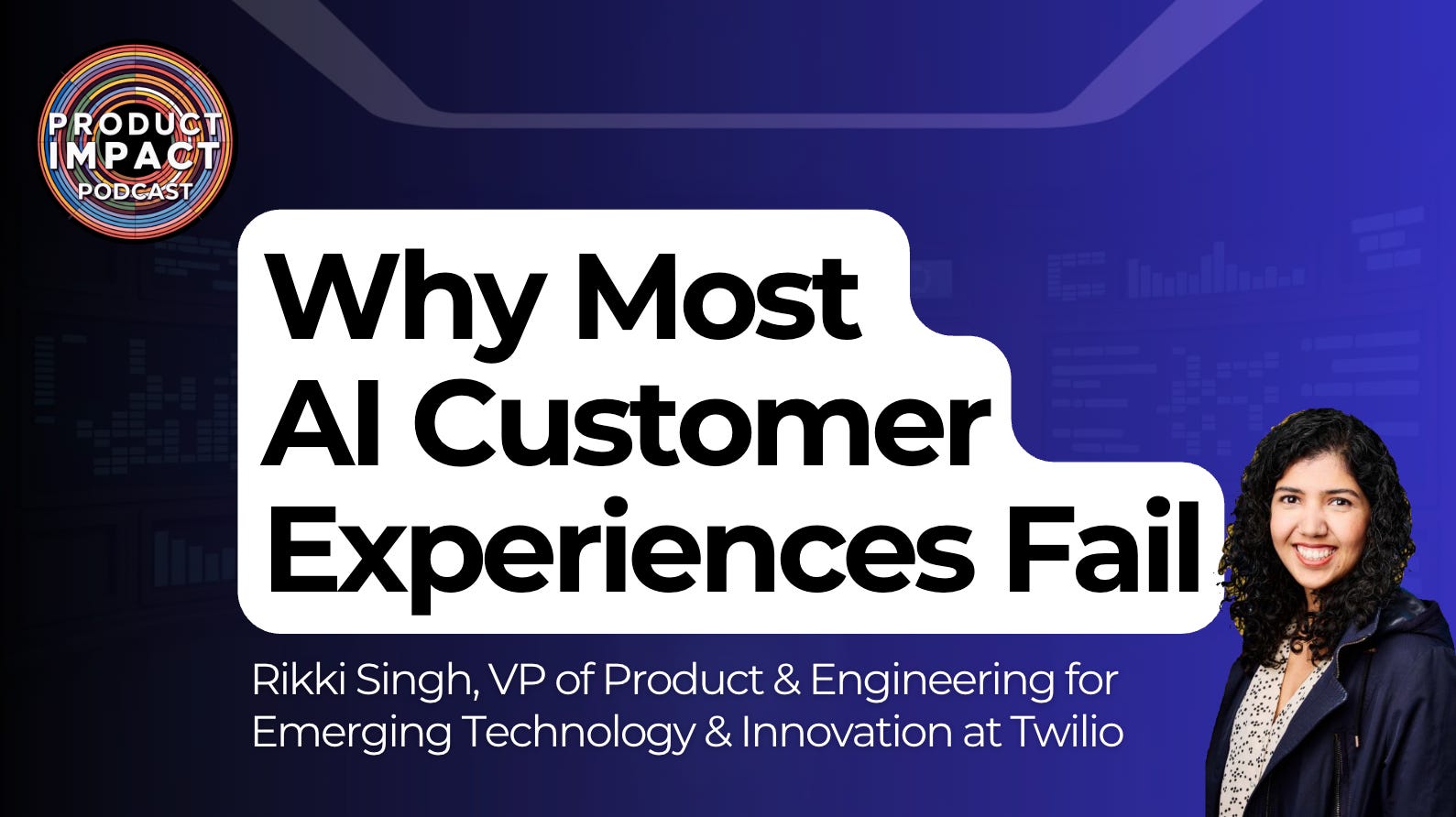
Rikki Singh leads product innovation at Twilio — what the company is calling its biggest launch in 17 years. Before Twilio she was at McKinsey, where she co-authored the foundational research on what makes a great PM. The Qualtrics 2026 CX Trends Report found nearly 1 in 5 consumers who used AI customer service saw zero benefit — the baseline she is working against.
Why AI CX is still FAQ automation with better packaging
Why AI spend is as unpredictable as AI upside
The wrapper that makes AI feel like it thinks
Vitamins vs painkillers: the product sense filter
How to protect long-horizon bets inside a big company
Why the brand — not the vendor — owns AI failure
Listen: Spotify | Apple Podcasts
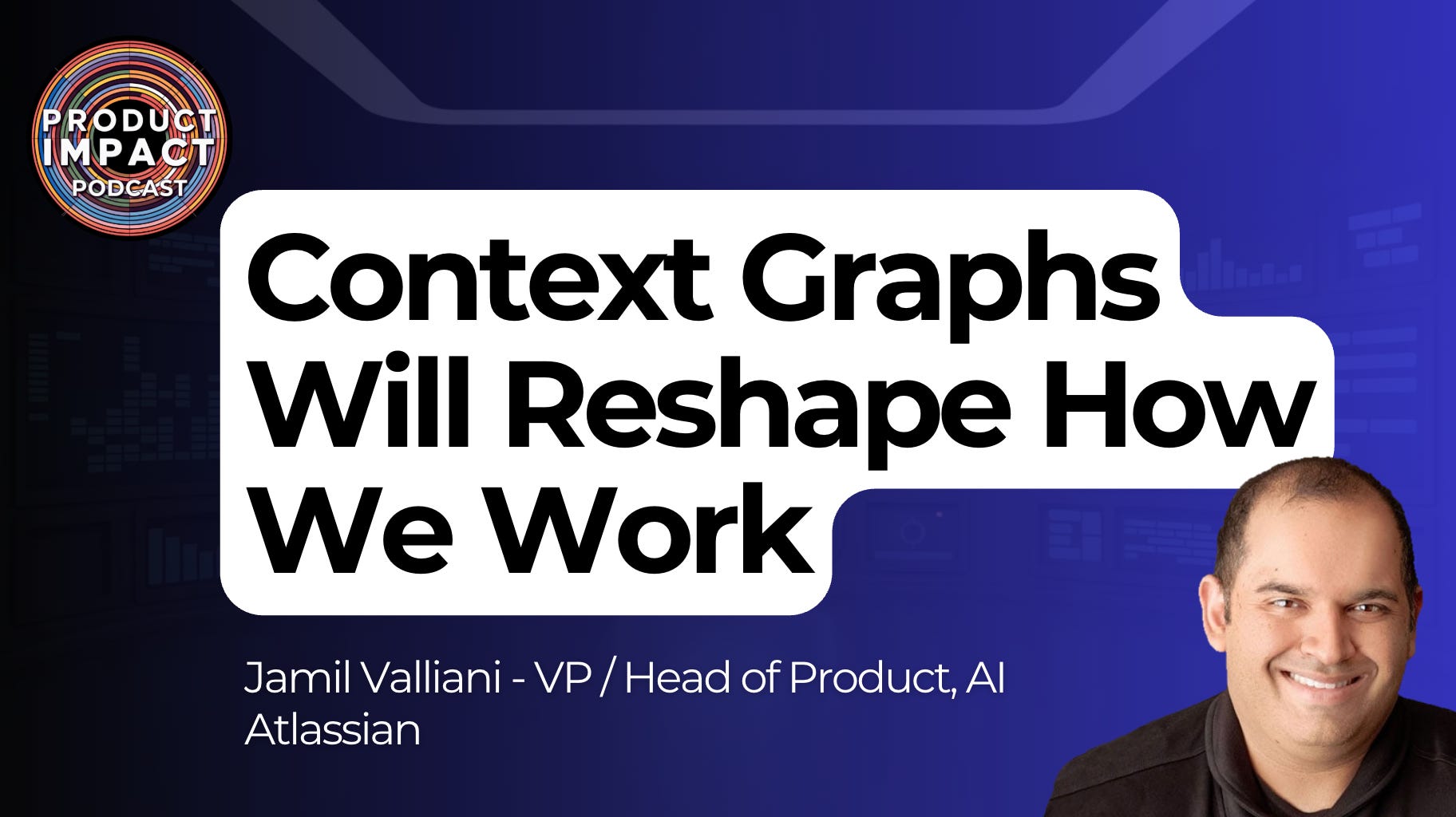
Jamil Valliani leads AI product at Atlassian, where he has spent three years building the Teamwork Graph across 300,000 companies. Recorded live at Team ‘26 in Anaheim, where Atlassian demonstrated what connecting 150 billion organizational objects produces: 44% more accurate AI answers using 48% fewer tokens, and a coding agent that reviewed 2 billion lines of code in 2 minutes.
Why your team spends 80% on gathering, not deciding
The adoption pattern that turns skeptics into converts
How to build trust with AI one small task at a time
Why giving AI less data often gets you a better answer
How leaders stop waiting for Friday status reports
From 2 ideas to 10: the creative unlock nobody explains
“You didn’t hire your team to write reports. You hired them to advance the business forward.” — Jamil Valliani
Listen: Spotify | Apple Podcasts
No one is measuring ROI & fewer understand knowledge graphs
We attended Atlassian Team ‘26 in Anaheim to cover the Teamwork Graph and what knowledge graphs actually mean for the future of work.
Key learnings:
Everyone is in such a rush to increase adoption numbers that no one cares to measure ROI, only velocity
In the rush to adopt, many orgs are discovering dozens of agents built by individuals that are unsanctioned and eating up tokens
While there’s excitement about announcements about getting access to more context, few understand what to do with the context that’s currently available to them today
📅 productimpactpod.com is the hub for AI product strategy, news, and analysis. All the articles featured in this edition are sourced from Product Impact’s own reporting.
WTF Is an AI-Native Org Anyways? Let’s Compare Airbnb & Meta’s Opposing Plans.
The term “AI-native” gets used without definition until it has to mean something operationally. Airbnb’s CHRO Iain Roberts gave the clearest working answer at Stanford: restructure before you deploy. His five moves — converting documentation to markdown, building reusable “skills” libraries, mining meeting recordings before institutional memory disappears, requiring leaders to personally build AI tools, and hiring org architects — are structural prerequisites, not technology decisions. Microsoft’s 2026 Work Trend Index found only 19% of AI users have reached the zone where AI actually compounds knowledge work. Airbnb is building toward that 19%. Most organizations are spending to reach 88% adoption while still operating in the 81% where AI doesn’t compound.
Meta posted $26.8 billion in Q1 2026 profit, announced 8,000 more layoffs, and reported “horrifically, historically low” employee morale — all three within the same quarterly cycle, and all structural rather than cyclical. Anthropic’s Economic Index from March 2026 found experienced AI users dramatically outperform newcomers — not because of tool access, but because of how they use it. The organizational design question is whether your structure accelerates that difference or suppresses it.
Read at productimpactpod.com →
OpenAI & Anthropic Are Charging Us Way More Than We Need
Stanford’s 2026 AI Index found inference costs dropped roughly 90% over 18 months. Enterprise AI budgets went the other direction: Forrester’s Q1 2026 found 78% of enterprises exceeded their 2025 budget by an average of 47%, and Gartner found spend climbing faster than value metrics in every tracked category.
Engineers who deliberately match task complexity to model capability pay 15 times less per query than those defaulting to frontier. Anthropic’s extended thinking feature bills at a 2x–5x output multiplier on top of the Opus base rate. The AI Value Acceleration Token Economics Crisis report found power users running $500–$3,000+ per month. The frontier-model upsell follows the iPhone playbook: premium defaults, friction for alternatives, the appearance of necessity. Most of what runs on Opus would run adequately on Sonnet, and almost no one is running the comparison.
Read at productimpactpod.com →
AI Value Acceleration is building a report on where enterprise AI investments are actually creating value. If you’re responsible for a major AI investment — leading it, funding it, or proving it’s working — we want to talk to you.
Playbook for Knowledge Workers to Survive the AI Jobpocalypse
Stanford’s 2026 AI Index found employment for software engineers ages 22–25 is down 20% since 2024. Dario Amodei has said 50% of entry-level white-collar work disappears within one to five years. Research from MIT Media Lab, Microsoft, and CMU found AI use reduces cognitive engagement — workers producing output faster while generating less original thinking. The professional survival question is whether the work remaining after displacement is work you are positioned to do.
The playbook addresses four paths for senior knowledge workers: navigate the current org redesign, move to a better-positioned organization, pivot to an adjacent domain, or go independent. UX researchers, digital marketers, project managers, agency account managers, educators, and designers are the specific roles addressed — not because they are uniquely at risk, but because they are the professions where the gap between AI-assisted and non-assisted output is currently largest, and where the window to close that gap is still open.
Read at productimpactpod.com →
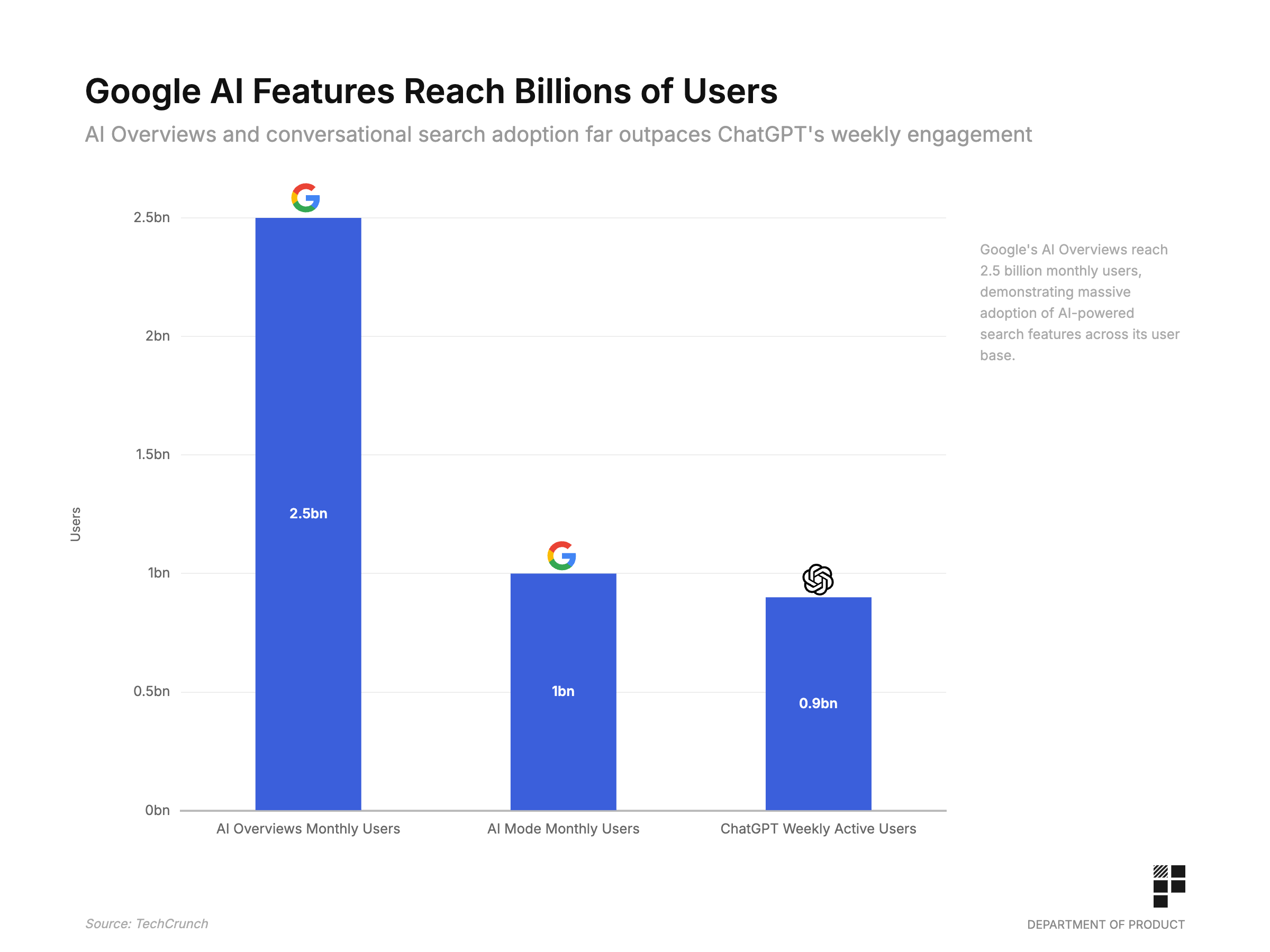
Google’s AI Overviews reach 2.5 billion monthly users. AI Mode reaches 1 billion. ChatGPT’s weekly active user count is 0.9 billion. Distribution is Google’s structural advantage — and the question of whether that reach translates into agent utility is the most important unresolved problem in AI products right now. Source: TechCrunch / Department of Product.
AI Strategy News
54% of C-suite executives admit AI adoption is tearing their company apart. 75% say their AI strategy is “more for show” than actual internal guidance. 60% plan to lay off employees who won’t adopt — while 29% of those same employees admit to actively sabotaging the strategy. Survey of 2,400 global executives and employees. The executive who says it’s tearing them apart is managing the person working against it. Writer 2026 Enterprise AI Adoption Survey
Meta, Shopify, Spotify, and Pinterest all flagged rising AI inference costs as a drag on margins in their most recent earnings. CNBC is now reporting cheap AI competition could derail OpenAI and Anthropic’s IPOs. The companies subsidizing enterprise AI strategy are being squeezed from above and below simultaneously. CNBC, May 20 2026
Anthropic’s AI bills climbed 27% without any change to the pricing page. A new tokenizer — the layer that sits between text and the model and decides how many tokens words are worth — is more aggressive than its predecessor. Same sentence, higher bill. The change happened without a changelog. Medium, May 2026
Global enterprise AI spend is projected at $665 billion in 2026. 73% of those deployments will fail to deliver their projected ROI. Three years into the deployment era, this is a structural measurement failure. AI Governance Today
The AI threat to knowledge worker jobs is running years behind headline forecasts — not because it won’t happen, but because the organizational change required to realize the displacement is slower than the technology. The delay is a runway. The Agent Architect
Google’s AI Overviews reach 2.5 billion monthly users. AI Mode reaches 1 billion. ChatGPT’s weekly active user count is 0.9 billion. Google has the distribution, the compute, and the data — and yet AI agents still are not reliably useful at consumer scale. If Google can’t close that gap with all of that behind it, the capability problem is harder than the industry is pricing in. The Verge
The OpenClaw AI agent now runs on a Unitree G1 humanoid robot — understanding rooms, recognizing people, completing multi-stage physical tasks without a human operator issuing individual commands. Giving an AI agent autonomous control over physical hardware combined with human identity credentials has left the software security domain entirely. WIRED
Recent from Product Impact
The Browser Is the New Battleground: How AI Is Moving Out of Chat and Into Your Life
Team Work Is About to Transform and Atlassian Is Leading the Charge
The UX Researcher’s Guide to Claude, Claude Cowork, and Claude Code
PH1 has spent 14 years helping product teams prove impact — diagnosing where AI products fail to measure, improving LLM-powered experiences, and building AI vision that survives contact with real users. If your organization has no bottom-line AI returns, that is a solvable problem. Let’s talk.
Thank You for Supporting the Product Impact Podcast
The evidence on the context bet is early but consistent: the organizations getting real results built the prerequisites first. Atlassian built the graph before deploying the agents. Airbnb restructured before the first tool went live. The engineers paying 15x less matched the task to the model before defaulting to frontier. The order of operations is not a detail — it’s the whole answer.
Which of the three pieces is your organization missing? Forward this to the person who needs to answer that. Browse all episodes and analysis at productimpactpod.com.


